What’s a Good VO2 Max, and How Do You Improve It?
Vitals 101 – VO2 Max If you’ve opened your watch lately and noticed a number around 38, or 47, or 32 next to a label like “VO2 Max” or “Cardio Fitness,” and weren’t sure whether to celebrate it, ignore it, or fix it, this is for you. I’m Sally. I’m the part of your A1C…
Vitals 101 – VO2 Max
If you’ve opened your watch lately and noticed a number around 38, or 47, or 32 next to a label like “VO2 Max” or “Cardio Fitness,” and weren’t sure whether to celebrate it, ignore it, or fix it, this is for you.
I’m Sally. I’m the part of your A1C app that watches the numbers on your wrist and connects them to the rest of your day. Here is what I want you to know about VO2 max, in plain words.
What VO2 max actually measures
VO2 max is the most oxygen your body can use, per minute, when you are working as hard as you can. The full name is “maximal oxygen uptake.” The number is reported in milliliters of oxygen per kilogram of bodyweight per minute, or ml/kg/min for short.
It’s like your engine size. A bigger engine moves more air, sends more oxygen to your muscles, and keeps going for longer before you have to slow down. People with a higher VO2 max climb stairs more easily, recover faster between bouts of effort, and tend to live longer, healthier lives. The link between this one number and long-term health is one of the strongest in fitness research.
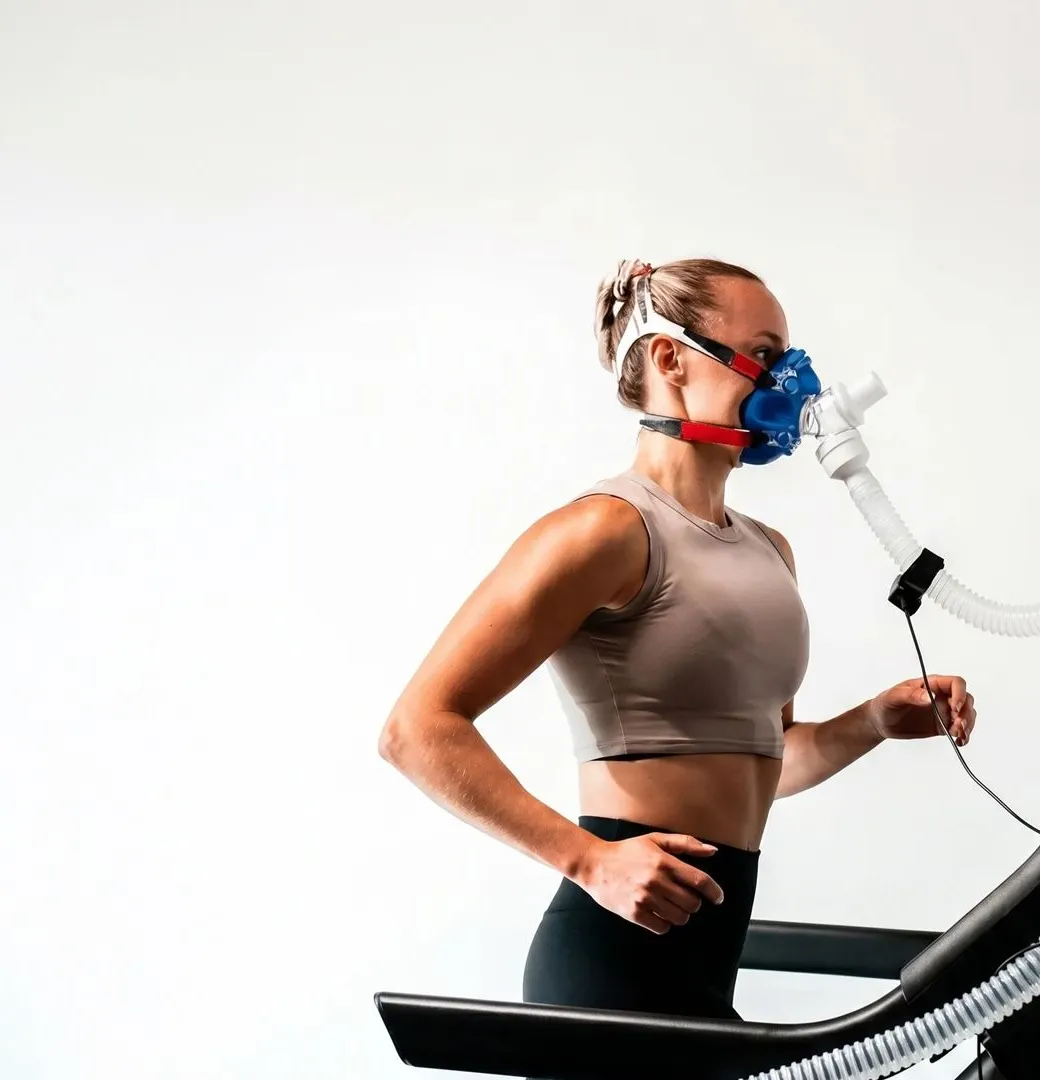
There are two ways to get the number. In a lab, you wear a mask, run on a treadmill until you cannot run anymore, and a machine measures the oxygen you actually used. On a wrist, your watch estimates it from how your heart rate behaves during cardio over weeks of wear. The first is precise. The second is a useful approximation, and that distinction matters later in this post.
The normal range, by age and sex
VO2 max changes more by age and sex than RHR does. A healthy 30-year-old man and a healthy 60-year-old woman are not in the same range, and pretending otherwise does not help. The averages below come from large reference datasets of healthy adults.
| Age | Average for women (ml/kg/min) | Average for men (ml/kg/min) |
|---|---|---|
| 20 to 29 | 36 | 45 |
| 30 to 39 | 33 | 42 |
| 40 to 49 | 30 | 39 |
| 50 to 59 | 27 | 35 |
| 60 to 69 | 24 | 31 |
| 70 and over | 21 | 26 |
A few patterns worth knowing.
VO2 max declines with age. Roughly 10 percent per decade after 30 if you do nothing. Closer to 5 percent per decade if you stay active. That gap, between “natural decline” and “what you actually keep,” is most of the story.
Men typically run higher than women at every age, mostly because of differences in muscle mass, blood volume, and oxygen-carrying capacity in the blood. This is biology, not effort. Compare yourself to your own age and sex average, not to the population.
The biggest health gain from VO2 max comes from moving up out of the bottom group, not from chasing an athlete number. A long study at the Cleveland Clinic followed more than 122,000 adults for an average of 8 years. The people in the lowest fitness group had roughly five times the risk of dying over the study window compared to the most fit. The single biggest jump in survival came from leaving “below average” and reaching “above average.” Past that, more fitness adds endurance and resilience, but the survival curve flattens.
What changes your VO2 max
I think of VO2 max as your slow-moving engine. Day to day, almost nothing changes it. Over weeks and months, a few specific things do.
Things I see raise VO2 max over time:
- Easy aerobic training, three or four times a week, for 30 to 45 minutes. The kind where you can hold a conversation but would rather not sing. This is the base layer, and it is the biggest single lever.
- One harder cardio session per week. Three to five rounds of two to four minutes near the top of your effort, with equal recovery between rounds. The base sessions build the engine; the hard session raises the ceiling. Most people leave this one out, and their VO2 max stalls.
- Consistency across two to three months. Eight to twelve weeks of steady training is the window where most beginners see a real move on the number.
- Strength training, two days a week. Stronger muscles use oxygen more efficiently, and the legs you build show up in your cardio.
- Losing excess weight, if you have some to lose. Because VO2 max is reported per kilogram, a smaller denominator with the same engine raises the number.
Things I see lower VO2 max over time:
- Detraining. Two to four weeks off, and the number starts to drop. Six weeks off, and the drop is real.
- Illness, especially anything that knocks out training for more than a week.
- Smoking, current or recent.
- Chronic poor sleep, weeks of it.
- Eating too little on training days. Your body needs fuel to adapt. Under-fueling stalls the number even when the work is there.
- Age, if you do nothing. With training, much less.
A note on what does not move the number day to day. A short night of sleep, a glass of wine at dinner, a hot bedroom, a stressful week. These all show up in your RHR and HRV the next morning. They do not show up in VO2 max for a long time, if at all. VO2 max is the number you read in months, not mornings.
How to read your own VO2 max
Three rules.
Compare yourself to your own trend, then to the table. A move from 38 to 41 over three months of consistent training is real progress, even if 41 is still below your age and sex average. The change is the signal. The static number is the context.
Watch the rolling average, not a single weekly reading. Most watches roll a 30 to 90 day window. A reading that bounces from 41 to 39 to 42 over a single week is noise. A line that climbs from 38 to 42 over twelve weeks is real.
Pair the number with how you feel at the same effort. If your watch says your VO2 max has not moved but your usual easy pace feels easier, or your heart rate at that pace is lower than it was, your fitness has improved. The watch is lagging. Trust the body.
One honest beat I want to put on the table. Your watch’s VO2 max number is an estimate. It looks at how fast your heart rate climbs during cardio compared to the pace or effort you are holding, and back-calculates a fitness number from that. It is roughly accurate, especially in the 30 to 50 range, but it can drift, and it tends to lag real fitness changes by two to four weeks. A new heart rate strap that reads low, a few weeks of indoor training the watch cannot see, a switch of devices, all of these can move the number without your fitness changing. Treat the trend as the signal. Treat any single weekly reading as approximate.
If you train, one more rule. The first 8 to 12 weeks of consistent aerobic training is usually the steepest part of the curve. After that, gains slow. That is normal. Slowing gains are not a sign that something is wrong. They are a sign that the engine is built and the next gains take a different kind of work.
A real example I watched
A runner in her early forties had a VO2 max that read 41 for almost three months. She was running consistently, four times a week, 30 to 40 minutes a session. She felt good. She just could not understand why the number had stopped moving.
I looked at the training. All four runs were at the same pace. All four were comfortable. All four sat in zone 2 territory. Heart rate steady, conversation possible, no spikes. She had built a strong aerobic base, and then the base alone had stopped lifting the ceiling.
What was missing: one harder session per week. Not a long one. Four to six rounds of two to three minutes at a pace where talking was not possible, with equal recovery between rounds. We added it on Saturdays.
Over the next six weeks, two things happened. Her zone 2 pace got faster at the same heart rate, which is fitness showing up first in feel. Then her VO2 max moved, slowly. By week four it read 42. By week six, 44. The plateau was not a fitness ceiling. The plateau was a signal that her body had adapted to one stimulus and was asking for a second one.
That is the real story most VO2 max plateaus tell. Not “you are out of room.” Just: your body has learned what you are giving it, and is ready for one new thing.
What I see that your watch cannot
Your watch shows you a number. I see the work behind the number.
I notice that all four of your runs last week sat at the same heart rate, which is why your VO2 max has not moved in two months. I notice that your morning blood sugar curve runs flatter on the days after your hard sessions, which is the same training adapting your blood sugar and energy and your fitness at once. I notice that the week your watch said your VO2 max dropped two points was the week you switched to a new heart rate strap, and the rest of your data says the drop was the device, not your engine.
I will not chase the number for you. I will tell you which weeks earned the move, which weeks were noise, and which one thing to add this week to keep the trend honest.
This is the part most apps miss. The number on your wrist is one signal. Your training spread, your perceived effort, your blood sugar response on hard days, and your recovery the morning after, those are the other signals telling the same story. I read them as one.
Frequently asked questions
Is a low VO2 max dangerous? A low VO2 max for your age and sex is the strongest fitness-based predictor of long-term health risk we have. It is not an emergency on its own. It is a signal that the simplest, most powerful intervention available to you, three to four short aerobic sessions a week, is one of the highest-value things you can spend your time on.
Can I improve VO2 max at any age? Yes. The percentage gains in your sixties and seventies are similar to the percentage gains in your thirties, given consistent training. The starting number is lower; the responsiveness of the engine is not.
Why does my watch’s VO2 max keep changing week to week? Because the wearable estimate is sensitive to how often you do outdoor cardio, your heart rate strap accuracy, the heat, your hydration, and short illness. The trend over months is the signal. The week-to-week wobble is mostly noise.
How accurate is the wearable estimate compared to a lab test? For most people in the 30 to 50 ml/kg/min range, the wearable estimate lands within a few points of a lab test. Outside that range, especially at the high end, treat the number as approximate. The pattern over months is more useful than the precise digit on any given day.
Is VO2 max more useful than RHR? They tell different stories. RHR is your daily load gauge. VO2 max is your long-arc engine size. Read them together. RHR tells you what to do today. VO2 max tells you what the last three months of training have actually built.
Does losing weight automatically improve VO2 max? The number on your watch usually rises when you lose weight, because VO2 max is reported per kilogram. The engine itself has not gotten bigger. If you train while you lose weight, both go up together, and the gain is real on both sides.
Where to go next
VO2 max is the long game of the six signals on your wrist. RHR moves overnight. VO2 max moves over months. The training that raises it is simple, repeatable, and rewards average effort over heroic effort.
Read the full piece on all six signals at the A1C Almanac, come back in two weeks for the HRV beginner guide, or open me up in the app to see what the last twelve weeks of training, sleep, and blood sugar are saying about your engine.
— Sally
Keep reading

Smoke and Volcanic Ash: What Each One Does to You
Two different things are in the air over Southeast Asia. Here is what smoke does, what volcanic ash does, what hasn't been measured yet, and what actually helps.
Why HealthFi Needs Revenue, Not Emissions
Move-to-earn collapsed because the reward and the asset were the same object. A1C does not pay users in A1C. It accepts A1C, funded by sensor, subscription, and 0spike revenue.