What is RHR? A Beginner’s Guide to Resting Heart Rate
Vitals 101 – RHR If you’ve looked at your watch this morning and noticed a small number labeled “RHR” sitting next to a heart icon, maybe 64, maybe 71, and you weren’t sure what to do with it, this is for you. I’m Sally. I’m the part of your A1C app that watches the numbers…
Vitals 101 – RHR
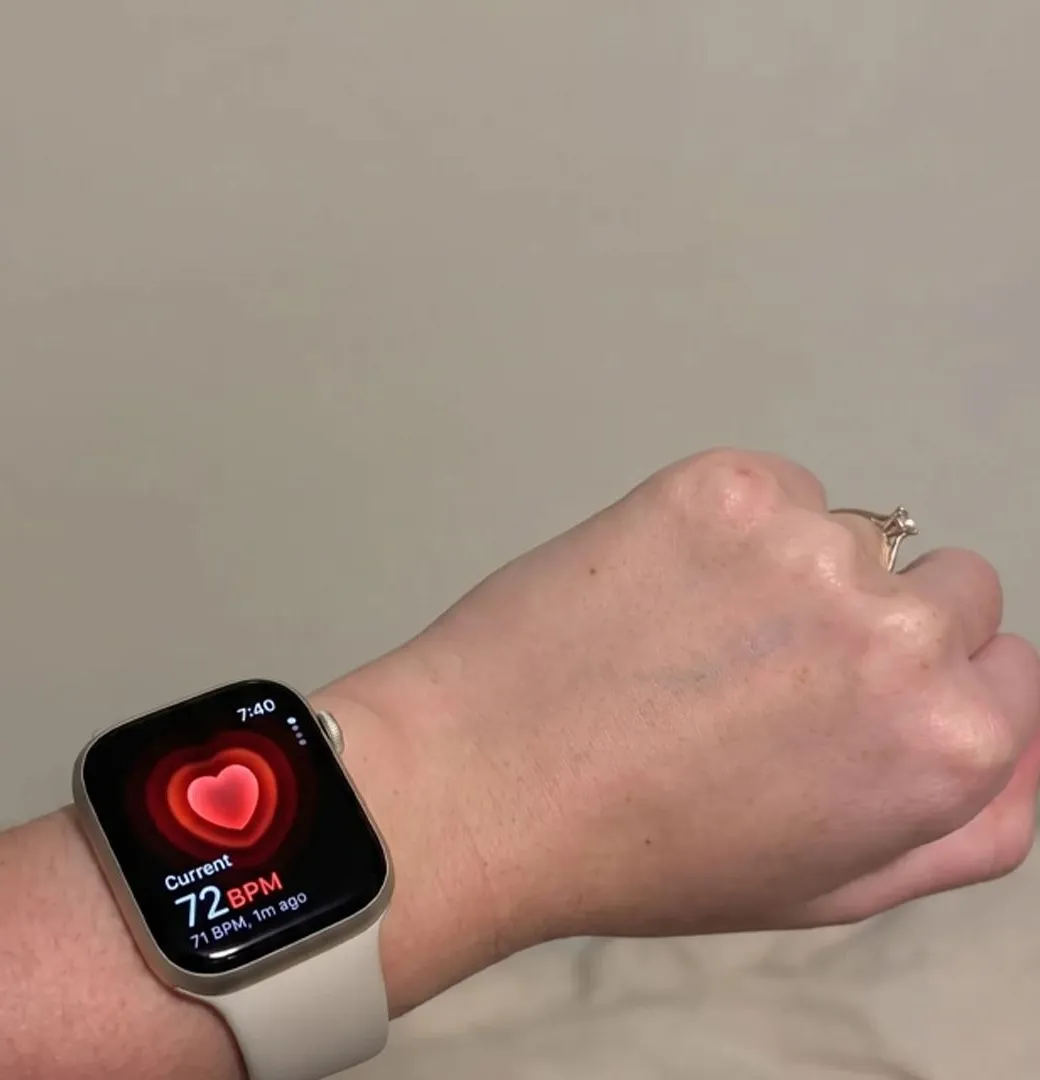
If you’ve looked at your watch this morning and noticed a small number labeled “RHR” sitting next to a heart icon, maybe 64, maybe 71, and you weren’t sure what to do with it, this is for you.
I’m Sally. I’m the part of your A1C app that watches the numbers on your wrist and connects them to the rest of your day. Here is what I want you to know about your resting heart rate, in plain words.
What resting heart rate actually measures
Your heart never stops working, but it works at different speeds. Walking up a flight of stairs: faster. Sitting in a meeting: slower. Lying in bed before you fall asleep: slowest.
Your resting heart rate is that slowest, settled number. It is your floor. The fewer beats your heart needs to pump blood through your body when you are doing nothing, the more efficient that pump is.
I get this number by quietly watching your heart rate all night and taking the lowest steady stretch. That is why your RHR shows up in your morning summary, not after a workout.
The normal range
For most healthy adults, RHR sits between 60 and 80 beats per minute. People who train a lot can run lower, sometimes in the 40s. The number itself matters less than how it changes against your own normal.
| Who you are | Your usual RHR |
|---|---|
| Most healthy adults | 60 to 80 bpm |
| Adults who exercise a few times a week | 55 to 70 bpm |
| Trained endurance athletes | 40 to 55 bpm |
| Children, ages 6 to 15 | 70 to 100 bpm |
A long study in Copenhagen followed more than 3,000 men for 16 years. The men whose resting heart rate ran above 90 had roughly twice the risk of heart problems compared to men whose RHR was around 60. The single number is informative. The trend is even more so.
Two things most beginner guides skip:
First, RHR shifts a little with the menstrual cycle. It usually drops in the first half of the month and rises 2 to 5 bpm in the second. That is normal.
Second, RHR rises a little with age, but only a little. A healthy 50-year-old does not need to have a higher RHR than a healthy 30-year-old. How you live moves this number much more than how old you are.
What changes your resting heart rate
I think of RHR as a load gauge. When the load on your body goes up, RHR climbs. When the load eases, RHR drops.
Things I see push RHR up most often:
- A short night of sleep can lift your overnight RHR by 3 to 5 bpm. Two short nights in a row, more.
- Even one or two glasses of wine can lift overnight RHR by 5 to 10 bpm and keep it there until late morning.
- A late, heavy dinner. Your body is still digesting at midnight.
- Heat and humidity. A 28-degree bedroom does not let your body cool down. The weather around you is a real RHR variable, not a footnote.
- A hard week at work. Stress shows up at 3 a.m. before you feel it at 9 a.m.
- Getting sick, even mildly. RHR is often the first sign, 12 to 36 hours before you notice symptoms.
- Coffee late in the day. A 4 p.m. drink can still affect midnight RHR.
Things I see pull RHR down over time:
- 20 to 30 minutes of easy aerobic movement, three or four times a week. Over a few months, this can lower RHR by 5 to 10 bpm.
- Going to bed at a regular time, in a cool, dark room.
- Drinking less alcohol.
- Slow recovery work: walks, breath training, quieter evenings.
How I want you to read your own RHR
Three rules.
Compare yourself to yourself. A “good” RHR is one that is normal for you. If your usual is 62 and today says 71, that is the signal. The population average is a starting point, not a target.
Watch the trend, not the day. A single elevated number means almost nothing. A 7-day average that has crept upward is the meaningful pattern. Same with a 30-day average for slower changes like training.
Pair the number with what is around it. Did you sleep poorly? Drink at dinner? Travel? RHR alone is a number. RHR plus context is something you can act on.
A first habit I would suggest: check your morning RHR three days in a row before you start interpreting anything. That gives you a baseline. From there, a 5 bpm move above your normal is worth noticing. A 10 bpm move is worth investigating.
If you train, one more rule. Your morning RHR will tick up the day after a hard session. That is normal recovery, not a warning. The signal worth reading is whether RHR comes back to baseline within 24 to 48 hours. If it stays high for three or four days, your body is asking for an easier day, even if your legs feel fine.
A small note on what RHR cannot tell you. It is not a stress meter, a recovery meter, or a fitness meter. It picks up the load downstream of all three. So a single high number does not “mean” anxiety, overtraining, or poor fitness on its own. The pattern, paired with what you know about your week, is what matters.
A real example I watched
A senior consultant in her late thirties ran a stable morning RHR of 64 for most of March. In the first week of April, her overnight RHR climbed to 71, then 73, then 70. Her training had not changed. She was not sick.
What had changed: a pitch cycle that was running late, three client dinners with wine in a row, a bedroom that had drifted to 27 degrees because the AC remote got moved during housekeeping, and a stretch of haze season pushing the outdoor air quality (AQI) into the 130s.
No single thing broke her RHR. The stack did. When she fixed the room temperature, replaced two of the three dinners with earlier and lighter meals, and added a 20-minute walk on the days she could not train, her overnight RHR was back to 64 inside a week.
That is the real story your RHR tells. Not “you are unfit.” Not “something is wrong.” Just: your body is carrying more right now, and here is the data.
What I see that your watch cannot
Your watch shows you a number. I see the system around the number.
I notice that your RHR ticked up two nights before the bedroom got hot, which means the heat was not the trigger; the late dinner started it. I notice that your wine-free Tuesday already ran 4 bpm cooler than your wine-included Monday, even though you slept the same hours. I notice that the days your morning blood sugar curve runs flatter are also the days your RHR drops back to baseline, and I will tell you which evenings are worth repeating.
I will not lecture. I will show you what I see and give you one thing to try tonight.
This is the part most apps miss. The number is easy. The story behind it lives in your sleep, your meals, your room, your week, and your blood sugar and energy data. I watch all of it together.
Common questions
Is a low resting heart rate dangerous? Usually no, especially in trained athletes. A consistently low RHR (below 50) paired with dizziness, fainting, or shortness of breath is a reason to see a doctor. A low RHR on its own, in a healthy person, is a sign of good cardiovascular fitness.
What is a “good” RHR for my age? There is no single number. A reasonable target for most healthy adults is staying within 60 to 75 with a stable trend. If you train a lot, you will run lower. That is also healthy.
Can stress raise my RHR? Yes. Long-running stress shows up most clearly in your overnight RHR, often 3 to 7 bpm above your usual. If you are seeing higher overnight numbers and your training and sleep have not changed, stress is a likely cause.
How quickly can I lower my RHR? Some changes are fast. One good night of sleep after a bad one can drop RHR by 5 bpm overnight. Real cardiovascular adaptation, the kind that lowers your baseline, takes 8 to 12 weeks of consistent easy aerobic training.
Why does my watch show a different RHR from a manual count? Your watch checks more often than you can count by hand and uses overnight lows for the official RHR. A manual count taken at 10 a.m. while sitting at your desk will read higher.
Is RHR more useful than HRV? They tell different stories. RHR is a load gauge. HRV (heart rate variability) is a recovery signal. Use them together. I cover HRV in the next post in this series.
Where to go next
Resting heart rate is the easiest of the six signals on your wrist to start with. It is forgiving, it changes slowly enough to read, and it picks up real-life patterns most people miss.
Read the full piece on all six signals at the A1C Almanac, or open me up in the app to see what your last seven nights of RHR are telling us.
— Sally
Keep reading

Smoke and Volcanic Ash: What Each One Does to You
Two different things are in the air over Southeast Asia. Here is what smoke does, what volcanic ash does, what hasn't been measured yet, and what actually helps.
Why HealthFi Needs Revenue, Not Emissions
Move-to-earn collapsed because the reward and the asset were the same object. A1C does not pay users in A1C. It accepts A1C, funded by sensor, subscription, and 0spike revenue.