Handstand and Dementia: What Goes Upside Down Has To Do With Your Hippocampus
Most people watch a handstand the way they watch a magic trick. Master Mukul kicks up against the wall, ankles softly cross, and the room does the same small intake of breath. This piece is about what you are actually watching. A handstand is not sending more blood to your brain. In a healthy adult,…
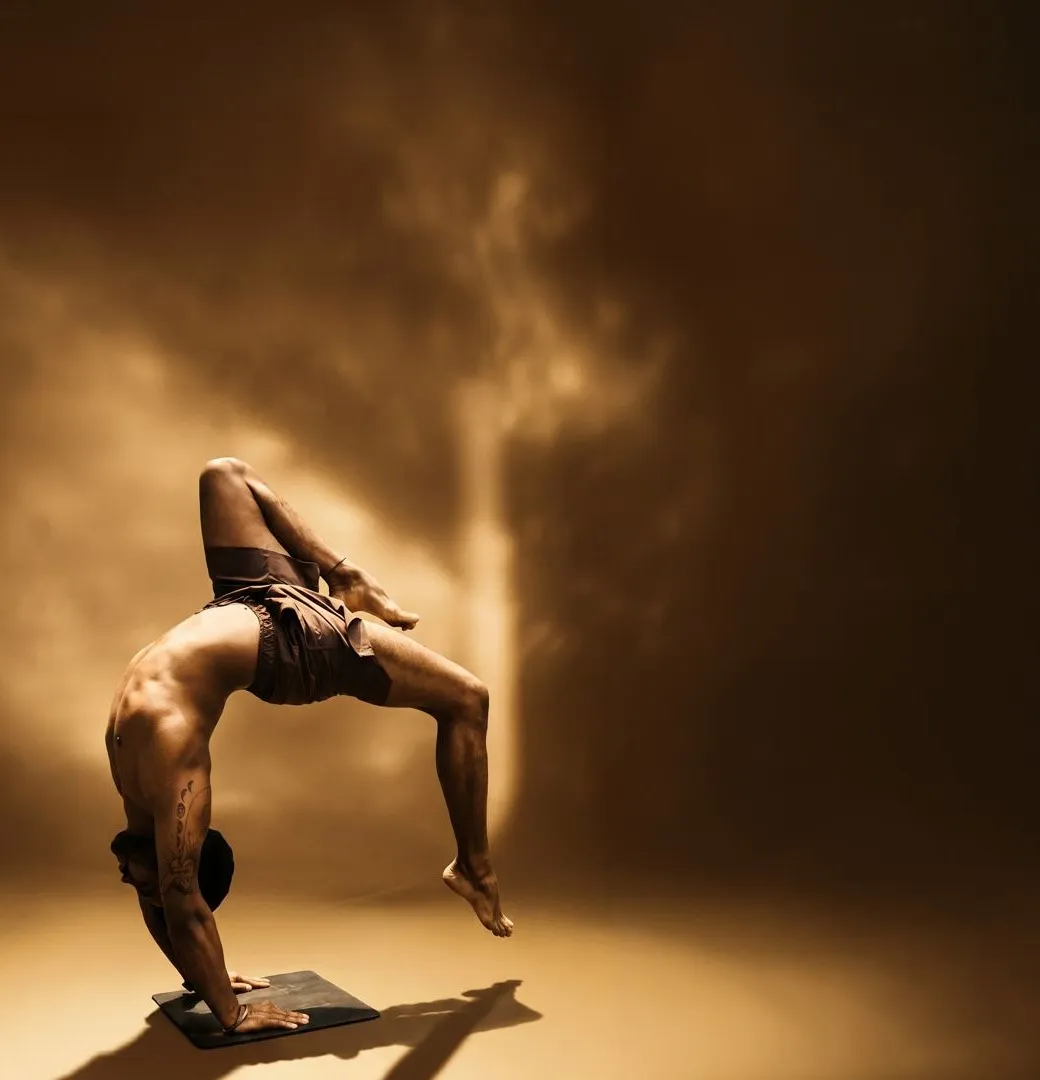
Most people watch a handstand the way they watch a magic trick. Master Mukul kicks up against the wall, ankles softly cross, and the room does the same small intake of breath.
This piece is about what you are actually watching.
A handstand is not sending more blood to your brain. In a healthy adult, the brain holds its own blood flow steady whether you are standing, sitting, or upside down. That is what cerebral autoregulation is for. The popular idea that an inversion “floods the brain with oxygen” mostly does not survive the studies.
So if a handstand is not a circulation hack, what is it.
It is the cleanest possible test of three systems at once. Balance. The vestibular system inside your inner ear that knows which way is up. And proprioception, your body’s internal map of where every joint is in space without looking. These three are not separate hobbies. They all feed into one structure in your brain.
The hippocampus.
The hippocampus is the part of the brain that builds memory. It is the part that remembers where you left your phone, that recognises your friend across the cafe, that knows the route from your office to your daughter’s school without thinking about it. It is also the first part of the brain that Alzheimer’s damages.
That is the link.
Forty-five percent
In July 2024, the standing Lancet Commission on Dementia Prevention, Intervention, and Care published its updated report. After reviewing the largest body of evidence assembled on dementia risk, the Commission concluded that forty-five percent of future dementia cases could be prevented or delayed by addressing fourteen modifiable risk factors across the life course.
Two of those fourteen are physical inactivity and diabetes. A third, high midlife LDL cholesterol, was newly added in 2024 based on data from more than one million participants.
A handstand practice does not address all fourteen. Nothing does. But it sits at the intersection of two of the biggest levers: physical inactivity and the brain’s tolerance for blood sugar swings, the latter of which Sally tracks for you every day. Forty-five percent is the ceiling. The interesting question is which of those fourteen levers you can actually pull this year.
Balance is one of the most underrated.
What the vestibular system is doing for your hippocampus
The vestibular system sits in the bony labyrinth of your inner ear. Fluid moves through tiny canals, hair cells fire, and your brain learns, dozens of times per second, whether your head is tilting, rotating, or upside down. It is the oldest sensory system you have, evolutionarily older than vision.
It is also wired directly into your hippocampus through two main pathways. One via the thalamus, one through the cingulate cortex. The hippocampus has cells whose only job is to know which way the head is pointing (head direction cells) and where the body is in space (place cells). Both depend on a clean signal from the vestibular system to do their work.
When that signal breaks down, the hippocampus loses an input it cannot easily replace.
A 2024 review in Frontiers in Neuroscience pulled together the clinical evidence. People with bilateral vestibular dysfunction have measurably smaller hippocampal volumes on MRI, worse spatial memory, and higher rates of cognitive decline than age-matched controls. The relationship runs both ways. Dementia damages the hippocampus, which makes balance worse. Lost balance starves the hippocampus of input, which makes the cognitive picture worse still.
The takeaway is the part most people miss. The vestibular system is trainable. Like a muscle, it gets stronger when it is asked harder questions. A handstand is one of the hardest questions you can ask it.
What happens when balance is the only thing you train
If the vestibular argument sounds theoretical, the cleanest experiment to date is not.
In 2017, a research group at the University of Hamburg published a randomised controlled trial in Scientific Reports (Rogge et al.). Forty healthy adults aged nineteen to sixty-five were assigned to either balance training or relaxation training. Two sessions per week. Twelve weeks. Neither group did any running, cycling, or weightlifting.
At the end of twelve weeks, the balance group had significantly improved memory and spatial cognition. The relaxation group had not. Cardiorespiratory fitness, measured on a stationary bike, did not change in either group.
This is the inconvenient finding for anyone who believes only the heart-pounding kind of exercise counts. You do not need to be out of breath. You need to be off balance. The brain systems that handle balance are wired to the brain systems that handle memory. Train one, you train the other.
This pattern holds beyond Rogge. A 2025 systematic review in Frontiers in Aging Neuroscience covering balance-based interventions in older adults and people with mild cognitive impairment found consistent improvements in spatial cognition, attention, and executive function, with the largest effects when balance was combined with cognitive load (counting, naming, reacting to a cue). A handstand, by definition, is a movement with constant cognitive load. You cannot daydream upside down.
The blood sugar layer
A1C exists because blood sugar is the part of your body’s signal that almost nobody was tracking until it was too late. The hippocampus is one of the structures most punished by blood sugar instability.
In Alzheimer’s brains, insulin signalling in the hippocampus drops to around ten percent of normal. Researchers sometimes call Alzheimer’s “type 3 diabetes” for exactly this reason. The hippocampus is one of the most glucose-hungry tissues in the body. When its insulin receptors stop working, its energy supply falters, and the structural damage follows.
The interesting part is that the average matters less than the swing. A 2024 systematic review and meta-analysis in the Journal of Alzheimer’s Disease pooled data on glycemic variability across multiple cohorts and found that people in the highest quartile of glucose swings had roughly a thirteen percent higher risk of Alzheimer’s disease than those in the lowest quartile, even when average blood sugar was comparable. Stability is the lever. Two people can have the same fasting glucose and the same HbA1c and still face very different brain trajectories depending on how flat their day-to-day curves are.
This is why we have written about it on the Almanac (see The Modifiable Brain and Hyperglycemic Neurodegeneration for the deeper science). It is also why a handstand and a continuous glucose sensor sit in the same conversation. They train and they measure the same vulnerable tissue from two sides.
Mukul builds the input the hippocampus needs to stay alive. Sally watches the fuel.
What you actually do on Monday
Most people will read this, agree with the science, and not kick up against a wall.
That is fine. The handstand is the visible expression. The unseen part is the balance and proprioceptive work that builds up to it. Almost all of it is accessible without leaving your apartment.
Three places to start, in order of difficulty.
A single-leg stand. Stand on one leg, eyes open, near a wall in case you lose it. Hold for thirty seconds. Switch legs. Build to a minute, then close your eyes for five seconds at a time. A 2022 meta-analysis in the British Journal of Sports Medicine found that midlife adults who could not balance on one leg for ten seconds had an eighty-four percent higher all-cause mortality risk over seven years than those who could.
A tandem stance. Heel of the front foot touching the toe of the back foot, as if walking a tightrope. Same protocol as the single-leg stand. Make it harder by turning your head side to side, which feeds your vestibular system directly.
The downward-dog-to-pike progression. From a downward-facing dog, walk your feet forward until your hips stack over your shoulders. Lift one leg, then the other, in small experiments. This is the entry point to the handstand. You do not need to ever get inverted. The work happens in the asking.
Three sessions a week, five to ten minutes each. The cost is small, but the thing it is buying you is your spatial memory at sixty-eight.
A note on who should be careful
The cleanest evidence for handstand and headstand safety is in trained practitioners. People with uncontrolled high blood pressure, glaucoma, or a history of detached retina should not do full inversions without medical clearance. A small percentage of healthy people show increased intraocular pressure during headstands, which is one reason the practice should be built gradually under a teacher who knows your body.
This is also why we are doing this with Mukul. He has been teaching long enough to know what your hands look like when they have never held weight, and his progressions for beginners are slower than the Instagram version of yoga lets on.
What Sally sees
You will not get a notification from Sally that says “your handstand was good for your hippocampus today.” That is not how she works.
What she will do is what she has always done. She watches your blood sugar against your own baseline. She watches your overnight resting heart rate and your heart rate variability for signs that you actually recovered. She watches your post-meal trace for the patterns that point at the same brain vulnerability we have been talking about. And when those patterns shift, she tells you.
The handstand is the input, the data is the read. Both are training the same structure.
The hippocampus is not a magic organ. It is a piece of tissue that runs on fuel, signal, and use, and that quietly atrophies when any one of those three goes missing. The Lancet Commission tells us that close to half of dementia is on the modifiable side of the ledger. The science of balance training tells us where some of the cheapest hours go.
A handstand against a wall on a Sunday morning is one of them.
Practice with Master Mukul
Master Mukul is back in India for the season, but he still teaches handstand and inversion work online. Live sessions, video feedback on your form, the same progressions he uses in person. If you want a coach who can see your hands shake from across a screen and tell you why, that is the way in.
If you want to see what your hippocampus is doing in response, that is what we built A1C Insights for. Sally watches the blood sugar side, while Master Mukul teaches the balance side. The brain that benefits is the same one.
References
- Livingston G, Huntley J, Liu KY, et al. Dementia prevention, intervention, and care: 2024 report of the Lancet standing Commission. The Lancet. 2024;404(10452):572-628.
- Rogge AK, Röder B, Zech A, et al. Balance training improves memory and spatial cognition in healthy adults. Scientific Reports. 2017;7:5661.
- Sánchez-Rodríguez C, Cuevas-Mejía L, et al. Vestibular dysfunction and its association with cognitive impairment and dementia. Frontiers in Neuroscience. 2024;18:1304810.
- Erickson KI, Voss MW, Prakash RS, et al. Exercise training increases size of hippocampus and improves memory. PNAS. 2011;108(7):3017-3022.
- Araujo CG, de Souza E Silva CG, Laukkanen JA, et al. Successful 10-second one-legged stance performance predicts survival in middle-aged and older individuals. British Journal of Sports Medicine. 2022;56(17):975-980.
- Steele JR, Yannakoulia M, et al. The Modifiable Brain: Metabolic, Vascular, and Lifestyle Determinants of Cognitive Resilience in Aging. A1C Almanac, 2026.
- de la Monte SM, Wands JR. Alzheimer’s disease is type 3 diabetes: evidence reviewed. Journal of Diabetes Science and Technology. 2008;2(6):1101-1113.
- Lee DY, Kim J, Park S, et al. Increased risk of Alzheimer’s disease with glycemic variability: a systematic review and meta-analysis. Journal of Alzheimer’s Disease. 2024 (Epub).
The A1C Insights app, products, and services are designed to support your health and wellness journey through education, awareness, and lifestyle insights. They are not intended for diagnosing, treating, managing, preventing, or curing any medical condition. Always consult a qualified healthcare professional before changing your exercise practice, particularly if you have eye, blood pressure, or neurological concerns.
Keep reading

Smoke and Volcanic Ash: What Each One Does to You
Two different things are in the air over Southeast Asia. Here is what smoke does, what volcanic ash does, what hasn't been measured yet, and what actually helps.
Why HealthFi Needs Revenue, Not Emissions
Move-to-earn collapsed because the reward and the asset were the same object. A1C does not pay users in A1C. It accepts A1C, funded by sensor, subscription, and 0spike revenue.